Medford at a glance
- Before 1850Shasta and Takelma peoples live and travel across the Bear Creek and Rogue River landscape.
- 1853–56Treaties, war and forced removal transform the region.
- 1883–85Land for a depot is platted; the first train arrives; Medford incorporates.
- 1900–15Orchard speculation fuels extraordinary growth before the boom breaks.
- 1930s–40sDepression-era political turmoil gives way to Camp White and wartime change.
- 1950s–80sWood products, hospitals, I-5 and suburban shopping reshape the city.
- 2020sThe Almeda Fire and continued growth put renewed attention on the Bear Creek corridor and downtown.
A place before the city
Medford sits on the Bear Creek valley floor, within the larger Rogue River watershed. This was not empty land awaiting a railroad. Shasta and Takelma peoples lived in and moved through the central valley and surrounding country, using routes between the creek, river and uplands. A city boundary drawn in 1885 cannot mark the beginning of the place’s history.
Gold discoveries and Euro-American settlement in the 1850s brought land seizures and violence. After the 1853 Table Rock treaty and the Rogue River War of 1855–56, federal authorities forcibly removed many Native people from their homelands to reservations at Grand Ronde and Siletz. Descendants remain present. The BLM describes continuing Takelma connections and Tribal stewardship at the Table Rocks; their history extends far beyond this short overview.
Why the railroad created Medford
Jacksonville, west of the valley floor, had become a mining and commercial center. When the Oregon & California Railroad planned its southbound line in 1883, it took a more direct route through the central valley. Four landowners gave it land along the west bank of Bear Creek for a depot. Railroad right-of-way agent David Loring named the platted town Medford after the Massachusetts city near his home.
The first train reached the site on January 18, 1884. Businesses gathered first along Front Street beside the depot, then along Seventh Street, now Main Street. The city’s history describes a quick-built town of hotels, stores, saloons, homes and a school on muddy streets. Medford incorporated on February 24, 1885; by 1890 it counted 967 residents. Rail access let a new commercial center form where freight could be loaded and people could arrive, even though the older county seat was elsewhere.
Orchards, speculation and a fast-growing city
The railroad made fruit grown around Medford practical to ship to distant markets. Apple, pear and peach orchards spread across the valley. Growers, investors, realtors and the railroad promoted the area’s climate and the promise of orchard profits. The boom was agricultural, but also a land and sales boom; capital and newcomers helped turn a small town into a regional city.
The Oregon Encyclopedia records growth from 1,791 residents in 1900 to more than 8,840 in 1910. Medford’s account describes a tent city during a housing shortage and a burst of building that brought schools, a Carnegie library, a new depot, paved streets, electric and telephone service, and fruit packing sheds by the rail yard. By 1910 Medford had overtaken Ashland as Southern Oregon’s largest city.
The orchard economy had several afterlives. Hillcrest Orchard’s history follows the shift from apples toward pears. Samuel Rosenberg bought Bear Creek orchard land in 1910; his sons Harry and David later turned premium pears into a national mail-order business when fruit prices fell during the Depression. Those individual success stories should not obscure the collapse of the speculative boom: overplanting, drought and falling returns hurt growers, and the city’s account dates its end to about 1915.
Roads, county government and the Depression
Medford’s next transport change came by road. The Pacific Highway ran through town by 1917, bringing automobile travelers and roadside trade. Timber companies also expanded their interest in the surrounding forests. In the late 1920s voters shifted the Jackson County seat from Jacksonville to Medford; the new courthouse opened in 1932. The exact year assigned to the transfer differs across local histories, which describe the vote, legal change and move at different stages.
The Depression exposed another side of civic life. A movement calling itself the Good Government Congress won county offices amid economic anger, then became entangled in a stolen-ballot investigation, violence and murder in 1933. The Medford Mail Tribune’s reporting against the movement won a Pulitzer Prize in 1934. It is a reminder that Medford’s civic history includes conflict over power and accountability, alongside growth and new buildings.
World War II changed the region unevenly
Camp White, an Army training installation northeast of Medford, was built in 1942. At its peak more than 40,000 soldiers were stationed there. Construction workers, troops and wartime contracts brought an enormous influx into a city of roughly 11,000 people in 1940. After the war, the camp’s hospital buildings were adapted for veterans’ care, while its industrial core helped make the later White City area a base for wood-products businesses. Camp White was outside Medford proper, but its effects reached city businesses and families.
The wartime story was very different for local Japanese Americans. Oregon Humanities documents that on June 1, 1942, thirty-eight people of Japanese ancestry from Jackson County, including thirteen families from Medford, were put on buses under military guard and sent to a detention center at Tule Lake. Twenty were U.S.-born citizens. Their railroad, restaurant and family histories were part of the region before the war. A history that counts incoming soldiers but leaves out neighbors who were taken away would be incomplete.
From timber and rail to healthcare and the highway
Postwar building demand helped wood products overtake fruit as a leading regional industry. Medford became a processing, shipping, finance and service center for the surrounding mills and forests. The city dates timber’s dominant period from the 1940s into the mid-1970s, followed by economic and environmental changes that reduced its role. The shift was gradual and affected workers and towns beyond Medford too.
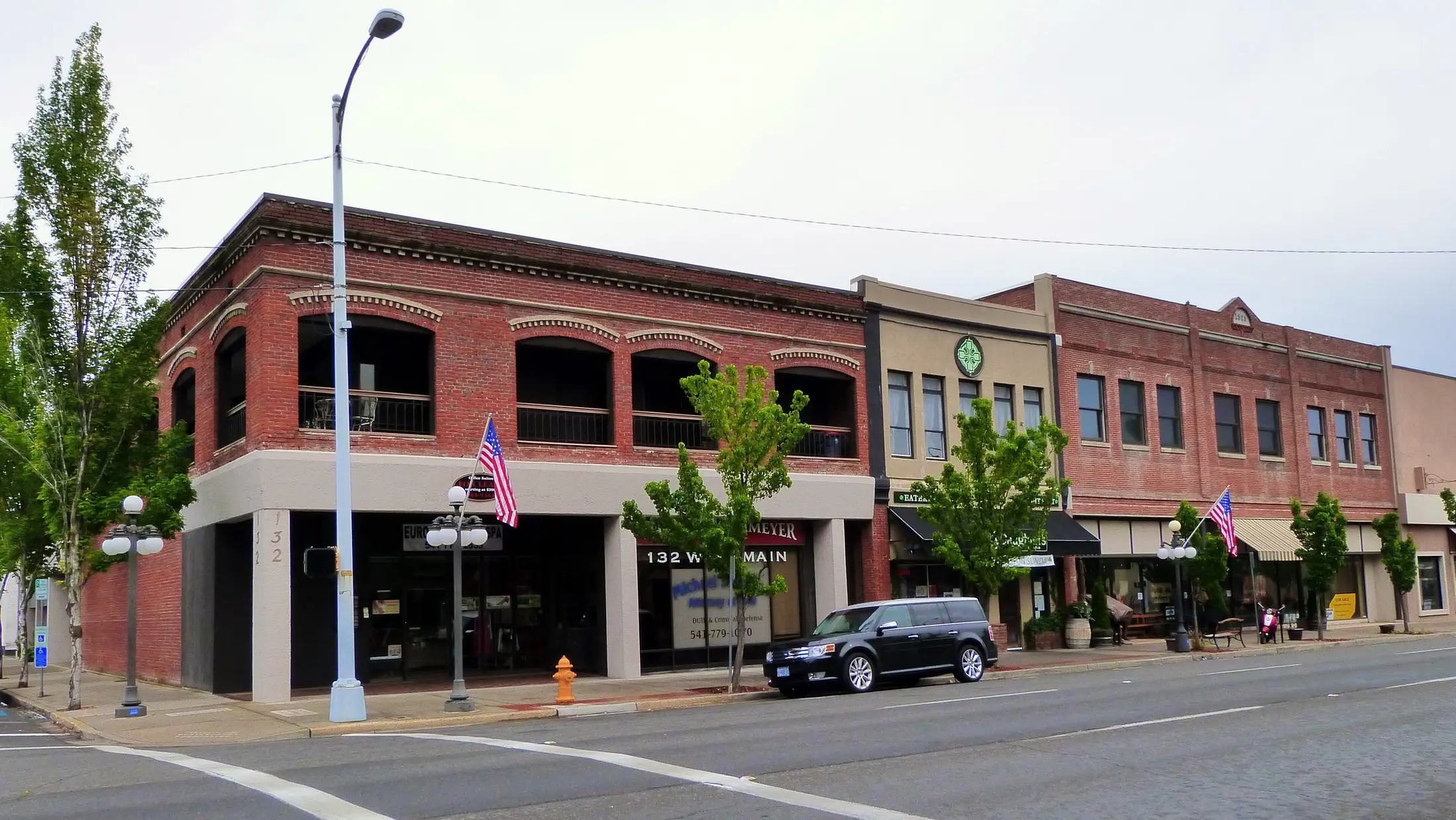
Healthcare became another anchor. Rogue Valley Memorial Hospital opened in 1958, Providence in 1966, and the city’s medical services grew to serve a much wider area. New housing spread outward. Interstate 5 bypassed the old rail-centered downtown, and shopping moved toward suburban centers and, after 1986, the Rogue Valley Mall. Many downtown buildings were remodeled or lost; others still show the city’s early commercial fabric. The downtown historic district later gained recognition on the National Register of Historic Places.
The city in the twenty-first century
Medford remains a retail, healthcare, government and service center for much of the Rogue Valley and nearby northern California. The 2020 census counted 85,824 residents, compared with fewer than a thousand in 1890. Orchards, wood products and the railroad still leave traces, but no single industry explains daily life in the city now. Downtown preservation and reinvestment coexist with newer neighborhoods, changing travel patterns and pressure on housing and public space.
The September 2020 Almeda Fire burned north along Bear Creek from Ashland through Talent and Phoenix toward south Medford. Its devastation fell unevenly across the corridor; it should not be described as a fire that destroyed all of Medford. The Rogue Valley Council of Governments documents damage to homes, businesses and riparian habitat and monitors the long-term effects on Bear Creek. The event made an old geographic fact impossible to overlook: the creek links communities even when city boundaries separate them.
Another change to the civic record came when the Medford Mail Tribune ceased operations in January 2023 after more than a century. That loss matters to how the city remembers itself, particularly given the paper’s Depression-era reporting. The city opened Rogue X, a large public recreation complex in west Medford, in January 2024. The history of Medford is still being made and recorded by its residents, Tribal communities, local institutions and journalists.
See the layers for yourself
The City of Medford’s self-guided downtown walking tour covers 21 historic buildings. Its shorter route along North Central Avenue takes about half an hour, and the longer Main Street route toward the courthouse about an hour. Front and Main show how the depot, shops and civic buildings formed the early center; the city’s historic-preservation pages offer maps and building histories before you go.
For deeper research, use the Oregon Encyclopedia’s linked archival photographs and the Southern Oregon Historical Society’s collections. Historical images and celebratory city accounts are valuable evidence, but they do not tell every family’s story. Read them alongside the histories of Native people, Japanese American residents, laborers and later arrivals. For present-day stops, events and conditions, use the separate Medford community and activity guides.
Sources and further reading
These links lead to the historical institutions and local agencies used to check this account. Some sources cover the wider watershed; read them alongside the town specific sources.
- Oregon Encyclopedia: Medford ↗
- City of Medford: Historic Preservation and city history ↗
- City of Medford: Downtown Medford history ↗
- Oregon Historical Society: War and Removal ↗
- BLM: Takelma Today ↗
- BLM: Tribal stewardship of the Table Rocks ↗
- Oregon Encyclopedia: Hillcrest Orchard ↗
- Oregon Encyclopedia: Harry & David ↗
- Oregon Encyclopedia: Good Government Congress ↗
- Oregon Encyclopedia: Camp White ↗
- Oregon Humanities: Japanese American families in Jackson County ↗
- Rogue Valley Council of Governments: Almeda Fire and Bear Creek ↗
- Oregon Encyclopedia: Medford Mail Tribune ↗
- City of Medford: Rogue X opening ↗
- City of Medford: Downtown historic walking tour ↗