The Rogue River War and forced removal
The 1853 Table Rock treaties, attacks on Native communities, the 1855–56 war and forced removal preceded the founding of many of the region's towns. Tribal connections to these homelands continue.
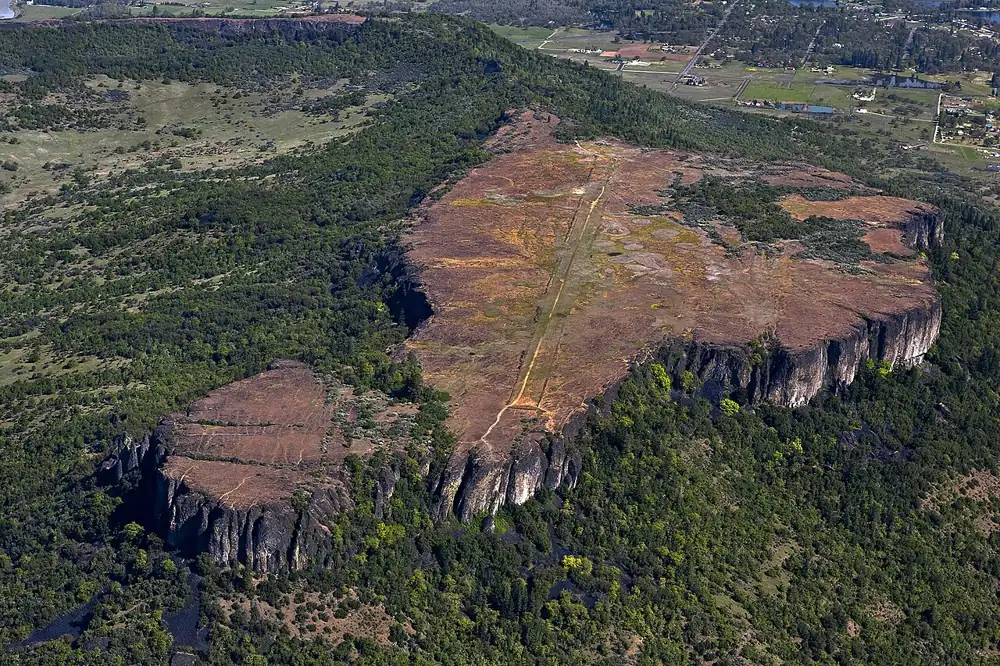 TABLE ROCKS · JACKSON COUNTY
Whose homeland was this?
Takelma, Shasta and Athapascan speaking peoples lived in the Rogue Valley and neighboring river country before American settlement. They were distinct peoples and communities; a broad historical label such as “Rogue River tribes” should not erase those differences. The Confederated Tribes of Grand Ronde name Takelma, Upper Takelma, Latgawa, Shasta, Applegate and Galice among the bands associated with the 1853 Rogue River treaty.
The influx of miners and settlers after the California gold rush and discoveries near Jacksonville brought land seizures and repeated violence. The Table Rock treaty and war records document how U.S. control of the region expanded.
Two Table Rock treaties, two different outcomes
Negotiators made a peace treaty on September 8, 1853, and a land cession treaty on September 10. The first was never ratified; the second was ratified in 1854. The latter gave up title to a large part of southwestern Oregon in exchange for a Table Rock reservation and promised goods, services and protection. The eventual permanent reservation was still undetermined.
Despite the ratified treaty's promise of protection, settlers attacked Native communities in 1855, and federal authorities later removed many survivors. The Tribal treaty account and Oregon Encyclopedia document these events from different institutional perspectives.
How did the final war begin?
On October 8, 1855, groups of white volunteers attacked Native camps near the Table Rocks. The massacre followed political agitation in Jacksonville and precipitated the final Rogue River War. Native groups did not respond as one force: some remained on the reservation, while others fled downriver, fought, or sought safety elsewhere. The war reached the lower Rogue and coastal region and ended in 1856 with the surrender of remaining leaders and the removal of most Native survivors.
Accounts and death estimates vary. The Oregon Encyclopedia cites an estimated 235 to 267 Native deaths in the war, alongside 50 soldiers and, by one account, 44 white civilians. Those figures are estimates from historical records; the linked Tribal accounts document removal and continuing connections to the region.
Removal did not end the story
The federal government forcibly moved Native peoples from the Table Rock Reservation and elsewhere in southwest Oregon. The Confederated Tribes of Grand Ronde recount a 33-day, 263-mile forced march north from Table Rock. Its removal page gives conflicting years for the march (1856 in one passage and 1857 in another), so this summary does not assign the journey a single year. Other survivors were taken by ship and later to the Coast Reservation and Siletz Agency. Routes and experiences differed by community.
Grand Ronde describes continuing connections to the Table Rocks and other homelands despite removal. Its cultural and treaty pages give the Tribe's account of those connections. The town histories in this collection cover later settlement in the same region.
Sources reviewed September 27, 2026. Accounts differ on the year of the Table Rock to Grand Ronde march; the linked Tribal removal page itself gives both 1856 and 1857. This brief account identifies the discrepancy rather than choosing a date unsupported by consistent evidence.